
The Lab: “Further Investigation of the BEDQ-A in a Sample of Female Athletes”
PURPOSE:
Female athletes appear to be at equivalent or increased risk for eating disorders (EDs). The Brief Eating Disorder in Athletes Questionnaire (BEDA-Q) was developed by Martinesen et al. (2014) as a short screening measure to distinguish between elite female athletes with a probable ED (pED) or no ED (noED). The present study investigated convergent validity of the BEDA-Q in a less elite sample.
METHODS:
Female athletes aged ≥18 years (N=505) completed the BEDA-Q and measures of depression, anxiety, emotion dysregulation, sleep, low energy availability, contextual body image, and excessive training/body disregard via online survey as part of a baseline assessment in a longitudinal study. We hypothesized that pED participants would report scores indicating greater pathology on all dependent measures compared to noED participants, with the exception of the muscularity dimension of contextual body image. We hypothesized no difference for muscularity based on Stewart et al. (2021). Hypotheses were tested with t-tests.
RESULTS:
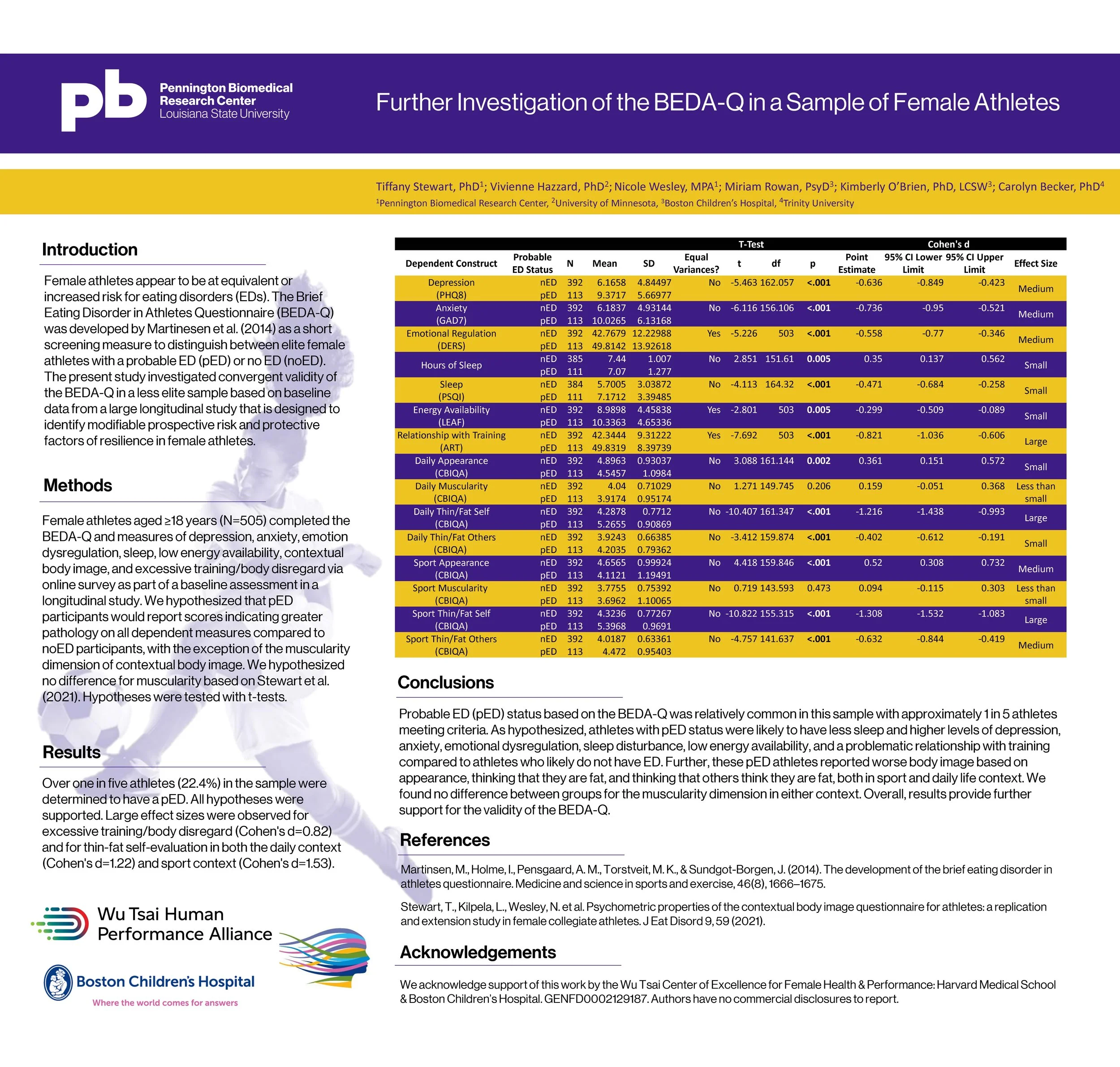
Over one in five athletes (22.4%) in the sample were determined to have a pED. All hypotheses were supported. Large effect sizes were observed for excessive training/body disregard (Cohen's d=0.82) and for thin-fat self-evaluation in both the daily context (Cohen's d=1.22) and sport context (Cohen's d=1.53).
CONCLUSIONS:
As hypothesized, athletes with pED status were likely to have less sleep and higher levels of depression, anxiety, emotional dysregulation, sleep disturbance, low energy availability, and a problematic relationship with training compared to athletes who likely do not have ED. Further, these pED athletes reported worse body image based on appearance, thinking that they are fat, and thinking that others think they are fat, both in sport and daily life context. We found no difference between groups for the muscularity dimension in either context. Overall, results provide further support for the validity of the BEDA-Q.
AUTHORS:
Tiffany Stewart, Vivienne M. Hazzard, Nicole Y. Wesley, Miriam Rowan, Kimberly O’Brien, & Carolyn Becker
KEYWORDS:
Student-Athlete, The Lab, Research, Science, Athletics Research, Eating Disorders, Female Athletes, Body Image